
Company culture is not your values on the wall.
It is not the mission statement on your website.
It is not the away day you held last year.
And it is not whether people describe the office as friendly.
Culture is what happens when you are not in the room. Some describe it as an organisation’s social operating system, the invisible set of expectations and behaviours that determine how work really gets done.
It is how decisions get made, how pressure is handled, how conflict is resolved and what gets tolerated and what gets challenged.
Many leaders think they have a culture problem, when in my experience, they usually have a clarity problem.
Culture Is Repeated Behaviour
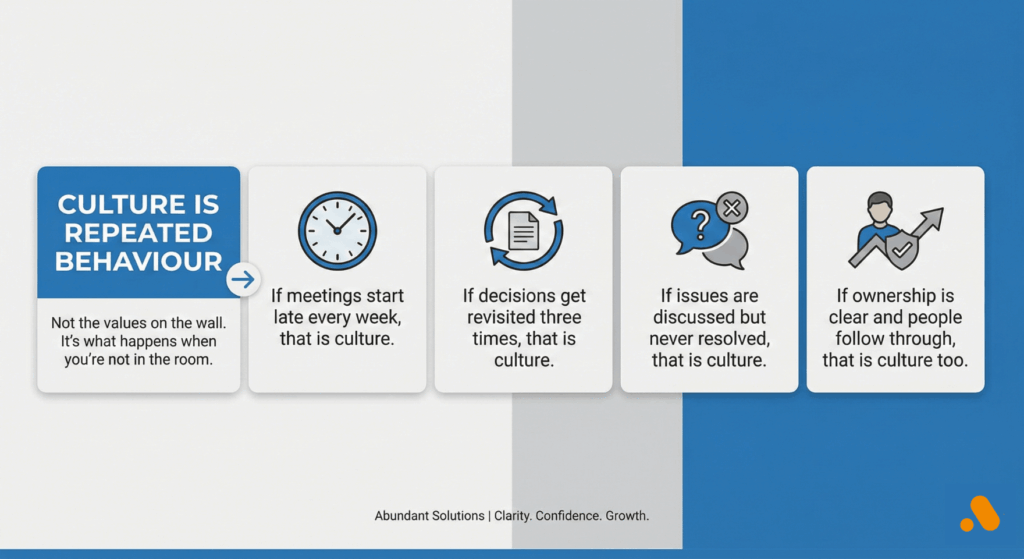
Strip it back, and culture is repeated behaviour.
If meetings start late every week, that is culture.
If decisions get revisited three times, that is culture.
If issues are discussed but never resolved, that is culture.
If ownership is clear and people follow through, that is culture too.
Culture is not what you say you value; it is what your business consistently does, and that behaviour is shaped by structure. In growing businesses, behaviour rarely drifts because people lack capability; it drifts because expectations are unclear or inconsistently reinforced. When leaders are explicit about standards and consistent in follow-through, behaviour stabilises. When they are vague or reactive, behaviour fragments. Over time, that fragmentation shows up as tension, delay and duplicated effort.
Culture Is Created by What Leaders Tolerate
This statement is the uncomfortable truth: whatever you tolerate becomes normal. If low standards are accepted or ignored, they spread; if accountability is optional, it becomes rare; and if strong performance is recognised and reinforced, it multiplies. Leaders shape culture far less through speeches and far more through their response to everyday situations. What you allow, what you question and what you follow up on sends a clear signal about what truly matters. Over time, those small moments compound and quietly define how the organisation behaves.
Culture Is a System, Not a Feeling
When culture feels off, leaders often focus on morale.
But culture is not primarily emotional. It is structural.
It is influenced by:
- Clear direction
- Defined roles
- Stable priorities
- Decision-making rhythm
- How problems are solved
If direction shifts weekly, culture becomes reactive; when roles overlap, friction increases; and when recurring issues are never properly addressed, frustration builds. That is not a personality issue; it is a design issue. Culture is the output of how the business is built to operate.
In practical terms, culture often reveals itself in small operational moments. Who prepares properly for meetings? Who owns the next step without being chased? How quickly are decisions escalated when something is unclear? These everyday habits tell you far more about culture than any value statement. When those habits are aligned, performance improves almost quietly; when they are misaligned, leaders find themselves compensating constantly.
A Simple Reflection
If you stepped away from your business for a week, what would continue?
Would decisions still be made confidently?
Would meetings still create momentum?
Would accountability still hold?
The honest answer to those questions is your culture, not the words, not the intent, but the behaviour.
And here is the commercial reality.
Culture drives speed, performance, retention and client experience. It affects how quickly opportunities are acted upon, how confidently teams make decisions and how consistently clients are served. A strong culture reduces friction within the business, allowing more energy to be directed outward toward growth.
When culture is unclear, everything feels harder than it should, whereas when culture is aligned, the business moves with less friction. If you are noticing tension, recurring issues, or slow decision-making, it may not be a people problem but a clarity and structure problem, and that is fixable.